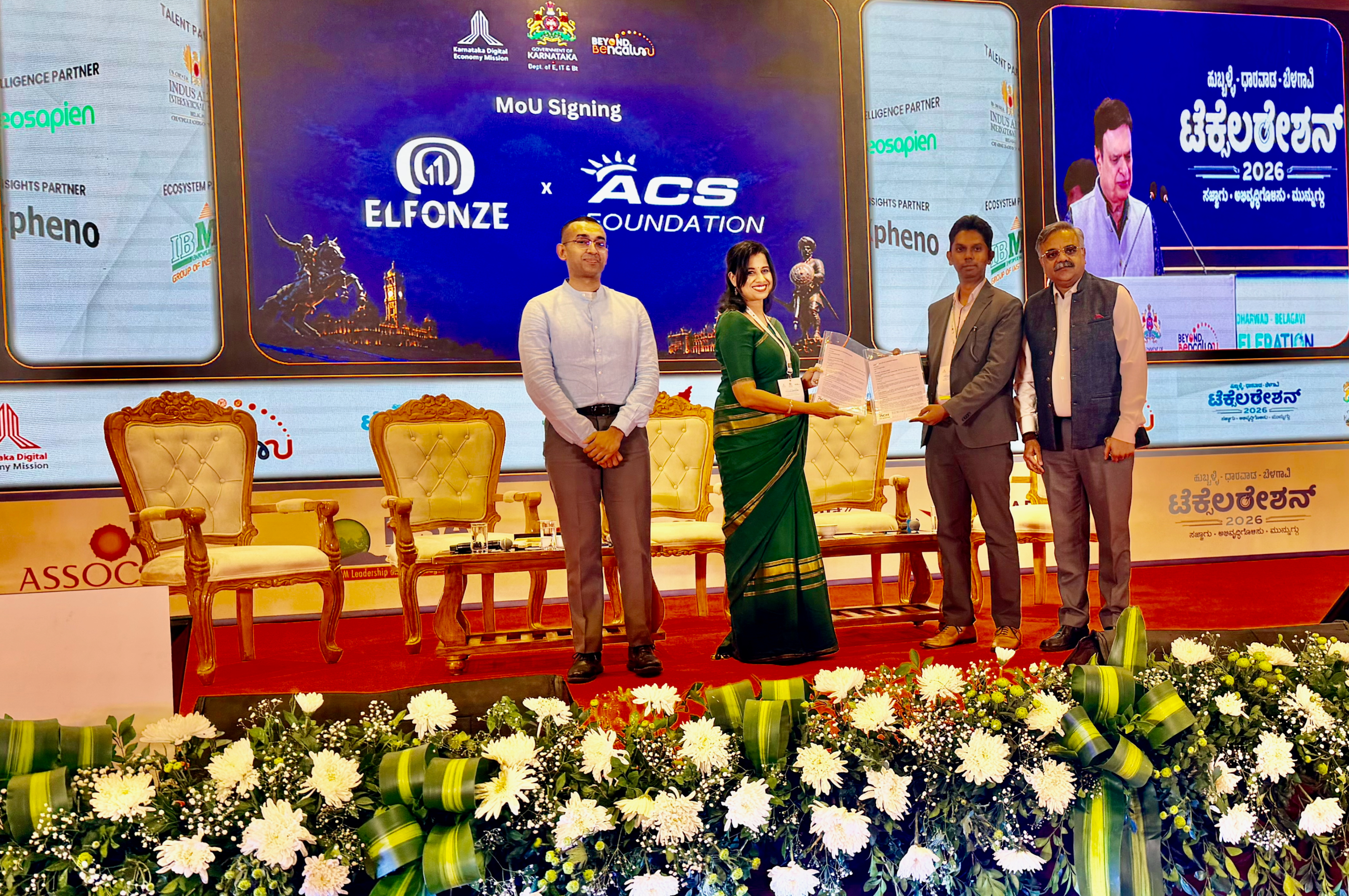
Pallavi Huralikoppi of ACS Foundation and Vijai Velu of Elfonze Technologies sign ESG partnership MoU at KDEM Techceleration 2026

Hubballi, Karnataka, 2 September 2026 — The Karnataka Digital Economy Mission today announced the signing of a three year Memorandum of Understanding between ACS Foundation and Elfonze Technologies Private Limited, establishing a strategic ESG and Sustainability partnership based in Karnataka and designed to scale across India and into international markets. The MoU was signed at Hubballi Dharwad Belagavi Techceleration 2026, held under KDEM's Beyond Bengaluru programme. It was signed by Ms. Pallavi Huralikoppi, Managing Trustee, ACS Foundation, and by Mr. Vijai Velu, Co-founder and Chief Executive Officer, together with Mr. Arun Kumaar Balasubramanian, Chief Sustainability Officer, for Elfonze Technologies. KDEM and the Government of Karnataka are facilitators to the collaboration and are not parties to the agreement.


Why the signing took place in Hubballi

Beyond Bengaluru is KDEM's programme to distribute digital economy opportunity across Karnataka's clusters rather than concentrate it in the state capital, and the choice of Hubballi for this signing reflects how the partnership is structured rather than a gesture towards a location.

Bengaluru anchors the global end of the work. It is designated in the MoU as the principal hub for ESG Global Capability Centre development, ESG technology, ESG talent, corporate engagement and research, and it will host the Centre of Excellence. That is demanding, high value work and it belongs where the depth of talent already exists.

The demand that sits unserved today is elsewhere. It is in the emerging cities and industrial clusters of Karnataka, in supplier MSMEs that face buyer disclosure requirements without the means to meet them, and in districts that receive CSR funding without a shared evidence base for where it should go. Serving both ends of that spectrum from a single state platform is the ambition, and launching among the constituency that has been underserved is the appropriate place to begin.


The problem the partnership addresses

Micro, small and medium enterprises represent approximately 25 percent of India's industrial emissions, close to 30 percent of national GDP and around half of manufacturing exports, according to Ministry of MSME and Ministry of Statistics and Programme Implementation reporting. Adoption of renewable energy technology among them remains near 21 percent, and the proportion able to produce credible Scope 1, 2 and 3 emissions inventories is smaller still.

Multinational and large corporate buyers are now embedding supplier emissions disclosure into procurement qualification, driven by the Bureau of Indian Standards and SEBI BRSR Core value chain requirements for listed entities and by the European Union's Corporate Sustainability Reporting Directive and Carbon Border Adjustment Mechanism for exporters. An Indian MSME that cannot report is progressively an MSME that cannot supply.

The picture on corporate social responsibility runs parallel. Approximately ₹6,600 crore of mandated CSR expenditure went unspent in FY 2023-24, on Ministry of Corporate Affairs National CSR Portal data. Four states absorb close to 37 percent of what is spent, while states holding roughly a third of India's population receive under 12 percent. The constraint is not corporate intent but the absence of shared infrastructure connecting available projects, verified local need and measurable outcomes.


What the partnership will build

Karman11 MSME Sustainability and Net Zero Platform.

The centrepiece of the collaboration is an affordable shared sustainability platform, delivered through ACS Foundation and built on Karman11, Elfonze's enterprise sustainability and decarbonisation platform.

Karman11 enables an MSME to account for Scope 1, 2 and 3 emissions, track energy, water, waste and materials performance, set science aligned reduction targets, model decarbonisation and renewable energy pathways, and generate disclosures their buyers will accept under the GHG Protocol, ISO 14064, BRSR Core, CDP and buyer specific formats. Its distinguishing characteristic is that it does not stop at measurement and reporting. Most sustainability software tells an enterprise what its footprint is and leaves the reduction to consultants and spreadsheets. Karman11 carries the same data forward into target setting, abatement modelling, intervention tracking and verified outcome, which is the half of the problem that determines whether a net zero commitment is met or merely published. Decarb11 continues within Karman11 as its decarbonisation module.

For this partnership the platform is delivered on shared economics built around clusters and industry associations, so that compliance grade capability costs a small supplier a fraction of what it would cost alone.

Kairos11 smart manufacturing for MSMEs.

Elfonze will extend Kairos11, its enterprise smart manufacturing and production planning system, to MSMEs and industries that cannot afford conventional enterprise software, through a shared or subscription model. Every deployment is tied to sustainability outcomes. Optimising production planning, scheduling, capacity, inventory and maintenance reduces energy, water, raw material and waste intensity per unit of output, and the operational data flows directly into Karman11 so that savings are measured and reported rather than asserted. Kairos11 changes what a factory does; Karman11 proves what changed.

Karnataka CSR Collaboration Platform.

A statewide platform cataloguing available and proposed CSR projects and connecting foundations, industries and institutions as a collaborative ecosystem. It will enable discovery, co funding, adoption and tracking, map every project to the 17 Sustainable Development Goals, and capture standardised baseline, outcome and impact data. Project data will be structured so that participating companies can draw on it directly for CSR reporting under Section 135 of the Companies Act 2013, BRSR Principle 8, GRI 203 and GRI 413 and SDG contribution statements, with an auditable trail running from expenditure to reported impact. Aggregated statistics will be available to the Government of Karnataka for SDG monitoring and policy.

Karnataka Development Data Map.

A digital map of Karnataka built on GIS at village level, layering administrative boundaries, lakes and water bodies, biodiversity, water sufficiency, sanitation and school and higher education availability. Integrated with the CSR platform, it allows projects to be targeted to evidenced need rather than assumption.

Industry and academia skills collaboration.

Programmes defined jointly with industry for emerging industrial roles including robotic operations and maintenance, dark factory troubleshooting, semiconductor mechanised cleaning, renewable energy equipment maintenance, metro systems maintenance and sustainable facilities operations, delivered through demand mapping, competency standards, faculty development, industry embedded training and placement pathways aligned to national skilling frameworks.

Industrial Schools Support Platform.

A replicable model enabling industries and academic institutions to establish and operate industrial schools producing technicians skilled across multiple trades with sustainability competency embedded. The platform supplies the school model, the competency framework, sponsor and host matching, funding and approvals guidance, shared learning content and a common outcome tracking framework. The role of the partners is to enable and de risk establishment, not to own or operate the schools.

Karnataka ESG and Sustainability Centre of Excellence.

The institutional home for the initiatives above, hosting the shared Karman11 data, analytics and AI capability, and undertaking research, innovation, corporate and GCC engagement, talent development, technology demonstrations, roundtables, policy dialogue and ESG benchmarking.

ESG Global Capability Centres and the Bengaluru opportunity

A significant strand of the partnership positions Bengaluru as a principal hub for ESG GCC development, covering design, stand up and managed operations of sustainability functions for global enterprises, alongside ESG technology, ESG talent, corporate engagement and research.

As sustainability reporting moves from a periodic disclosure exercise to a continuously operated enterprise function, the work of running it becomes a global capability centre workload with the same characteristics Bengaluru has already absorbed in finance, engineering and analytics. Karnataka intends to be where that function is hosted, staffed and matured.

Elfonze brings ESG GCC design and managed operations capability to this, together with carbon accounting, ESG reporting, assurance readiness, decarbonisation and energy, water and waste assessment, ESG data architecture and sustainability intelligence powered by AI. Its platform capability sits under Elfonze Labs, comprising Karman11, which takes an enterprise from carbon accounting through to verified decarbonisation, and Kairos11 for smart manufacturing and production planning. Karman11 is also the platform Elfonze deploys as a complementary layer alongside Oracle Sustainability, extending that stack from measurement and reporting into active reduction and optimisation. ACS Foundation brings corporate, institutional and government relationships, CSR and ESG ecosystem development, MSME onboarding through associations and clusters, and community level data collection.

The joint proposition is summarised by the partners as moving from ESG strategy to measurable impact, across a client journey of assess, strategise, implement, digitise, measure, report, assure and improve.


Pilots now open to industry

The partners will identify two to three GCCs and corporates in Karnataka for pilot programmes covering ESG maturity assessment, ESG reporting transformation and ESG GCC business case development. Parallel pilots will run for the MSME platform and Kairos11 with one or more industrial clusters, for the CSR Collaboration Platform and Development Data Map with an initial cohort of companies and districts, and for the Industrial Schools Support Platform with a first industry and academia partnership. Successful pilots are intended to scale nationally.

Target participants include GCCs, multinational and large Indian corporates, listed companies, MSMEs and industrial clusters, manufacturing, IT and ITES, technology, infrastructure, real estate, financial services and healthcare enterprises, supply chain intensive and export oriented organisations, family owned enterprises, public sector organisations, academic and skilling institutions and industry associations. Karnataka is the initial priority, with expansion planned to Hyderabad, Pune, Chennai, Mumbai, NCR and Ahmedabad, and the state platforms designed for replication in other states.


Governance and data protection

A Joint Steering Committee with representatives from both organisations will set priorities, approve initiatives, oversee the platforms and the Centre of Excellence and review performance, meeting at least quarterly. Measures under review include MSMEs onboarded and supplier disclosures generated, Kairos11 deployments, ESG GCC opportunities and centres established, CSR projects catalogued, funded and mapped to the SDGs, SDG impact data delivered to the Government of Karnataka, learners certified and industrial schools enabled, and carbon reductions and resource savings achieved.

All data collected or processed through the platforms will be handled under the Digital Personal Data Protection Act 2023 and a data governance framework approved by the Joint Steering Committee covering ownership, consent, anonymisation, access and retention. Data made available to the Government of Karnataka will be aggregated and anonymised unless otherwise agreed with the provider.


Quotes

Head, Beyond Bengaluru Mission, KDEM

"Beyond Bengaluru was never about relocating offices. It was about relocating opportunity. Bengaluru will host the global capability centres and the research, and it should. What this partnership adds is the other half, so that a supplier MSME in Hubballi or a district administration in Kalaburagi reaches the same capability. That is the test we hold every initiative to."

Ms. Pallavi Huralikoppi, Managing Trustee, ACS Foundation

"We have spent years watching good CSR intent lose itself between a boardroom decision and a village outcome. What we are building here is the connective tissue that has been missing, so that a company can see where the need is, fund it, and prove what changed."

Mr. Vijai Velu, Co-founder and CEO, Elfonze Technologies

"Sustainability is treated as a cost of compliance, and that framing is why so little of it survives a budget review. Our position is the opposite. Measure a factory properly and you find waste. Remove the waste and the numbers improve on both the carbon ledger and the profit and loss. We are bringing enterprise grade capability to organisations that were told they could not afford it, and we are doing it from Karnataka."

Mr. Arun Kumaar Balasubramanian, Chief Sustainability Officer, Elfonze Technologies

"An MSME that cannot report its Scope 3 position will quietly disappear from a multinational supply chain, and it will never be told that is what happened. Karman11 exists so that the smallest supplier in the chain can produce the same quality of disclosure as the largest, at a cost a cluster can carry together, and then actually reduce what it has measured."


About the organisations

Karnataka Digital Economy Mission (KDEM) is a joint initiative of the Government of Karnataka and industry, established to accelerate the growth of the state's digital economy across technology, startups, talent and cluster development, with Beyond Bengaluru as its flagship programme for distributing opportunity to Mysuru, Mangaluru, Hubballi, Dharwad, Belagavi and Kalaburagi.

ACS Foundation delivers outcome driven impact across education, entrepreneurship, future skills, sustainability, community development and CSR and ESG implementation, and brings corporate, institutional and government relationships together with programme implementation experience across Karnataka and India.

Elfonze Technologies is a bootstrapped global technology and consulting firm headquartered in Bengaluru, with development centres in Denver, Bhubaneswar, Pune, Hyderabad, Dubai and Chennai. Its capabilities span Oracle enterprise applications, cloud, AI and digital engineering, alongside an ESG and Sustainability practice covering diagnostics, Scope 1, 2 and 3 inventories, energy, water and waste audits, materiality, climate risk, decarbonisation planning, ESG reporting, assurance readiness, ESG technology, sustainability intelligence powered by AI, managed ESG operations and ESG GCC design and operations. Under Elfonze Labs it owns Karman11, its sustainability and decarbonisation platform, and Kairos11, an enterprise smart manufacturing and production planning system.


Experience Centers